Solid Carbide Drills vs HSS Drills: Which Is Better for CNC Production?
As manufacturers pursue shorter cycle times, tighter hole tolerances and more consistent batch production, solid carbide drills are increasingly being used in applications previously handled by high-speed steel drills. However, the most suitable choice still depends on the machine, workpiece material, hole depth and production requirements.
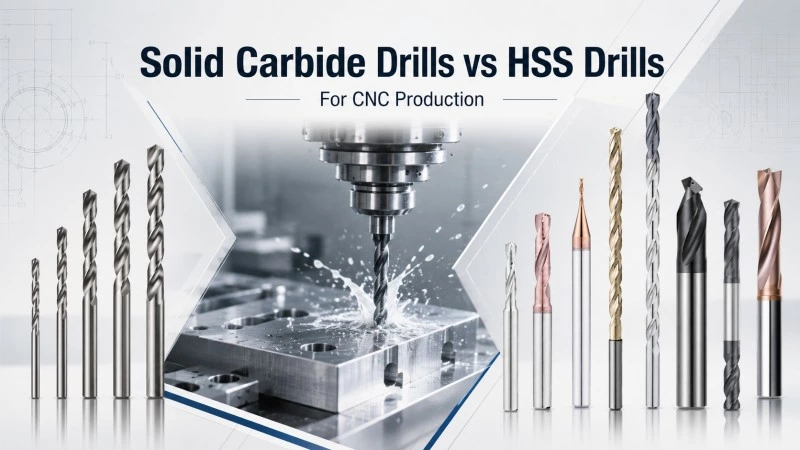
As manufacturers pursue shorter cycle times, tighter hole tolerances and more consistent batch production, solid carbide drills are increasingly being used in applications previously handled by high-speed steel drills. However, the most suitable choice still depends on the machine, workpiece material, hole depth and production requirements.
Drilling is one of the most common operations in metalworking, but the final result is influenced by much more than the nominal drill diameter. Tool rigidity, cutting-edge geometry, chip evacuation, coolant delivery, spindle condition and workpiece clamping can all affect hole quality and tool life.
A drill that performs reliably on a manual drilling machine may not be the most productive choice for a modern CNC machining center. Likewise, a tool designed for high-volume production may not be economical for occasional maintenance or repair work.
Why the Choice Between Carbide and HSS Matters
The comparison between solid carbide drills and high-speed steel drills cannot be reduced to one question:
Which material is harder?
The more useful questions are:
-
Which drill matches the machine and setup?
-
Which drill can maintain the required hole tolerance?
-
Which drill provides the lowest cost per acceptable hole?
-
Which drill is suitable for the production quantity?
-
Which drill can evacuate chips reliably at the required depth?
-
Which drill can operate consistently without frequent replacement?
Both HSS and solid carbide drills remain useful. The correct choice depends on the operating conditions and the production objective.
What Is an HSS Drill?
HSS stands for high-speed steel.
HSS drills are manufactured from alloy tool steel containing elements that improve hardness, heat resistance and wear resistance compared with ordinary carbon tool steel.
They are widely used in:
-
Manual drilling machines
-
Bench drills
-
General workshops
-
Maintenance and repair work
-
Low-volume production
-
Portable drilling equipment
-
Less-rigid machines
-
Applications requiring frequent resharpening
One of the main advantages of HSS is toughness.
An HSS drill can tolerate a certain amount of bending, vibration and impact without breaking immediately. This makes it practical for older machines, manually operated equipment and setups where spindle runout or workpiece clamping cannot be controlled precisely.
HSS drills also have a relatively low initial purchase price. For occasional drilling or small production quantities, this can make them an economical choice.
Their limitations become more apparent when higher cutting speeds, tighter hole tolerances or stable batch production are required.
What Is a Solid Carbide Drill?
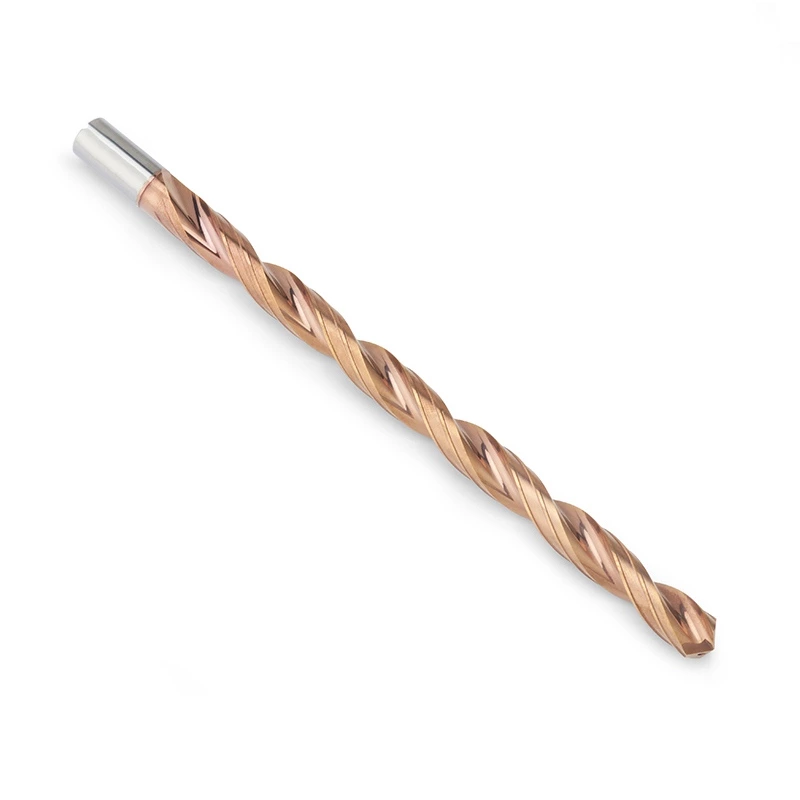
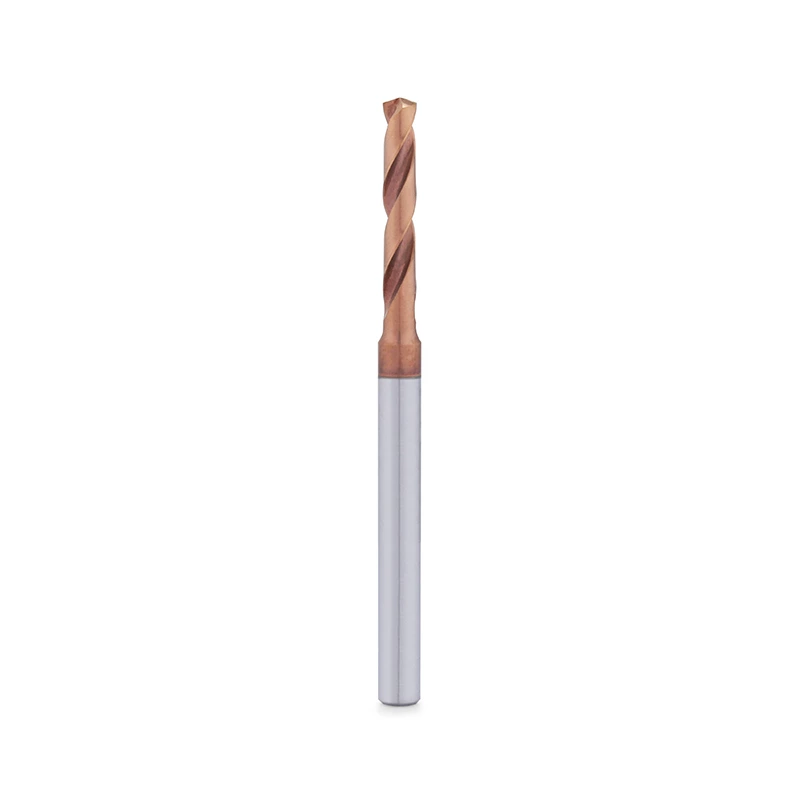
A solid carbide drill is manufactured from cemented carbide rather than tool steel.
Cemented carbide combines hard carbide particles with a metallic binder. This structure gives the drill high hardness, strong wear resistance and significantly greater rigidity than HSS.
Solid carbide drills are commonly used in:
-
CNC machining centers
-
Automated production lines
-
High-volume manufacturing
-
Precision holemaking
-
Deep-hole drilling
-
Internal-coolant drilling
-
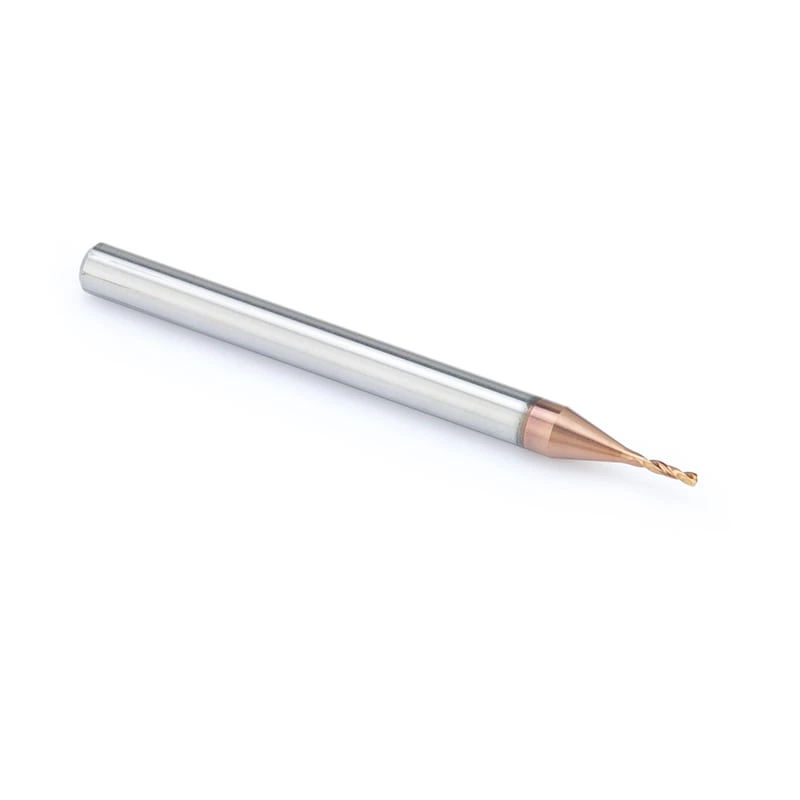
Micro drilling
-
Difficult-to-machine materials
-
Applications requiring repeatable tool life
Because carbide is highly rigid, it can maintain the designed geometry more effectively under stable cutting conditions.
This rigidity can support:
-
More consistent hole diameters
-
Better hole-position accuracy
-
Reduced tool deflection
-
Higher cutting-speed potential
-
More stable drill-point engagement
-
Improved batch repeatability
However, carbide is less tolerant of bending and impact than HSS.
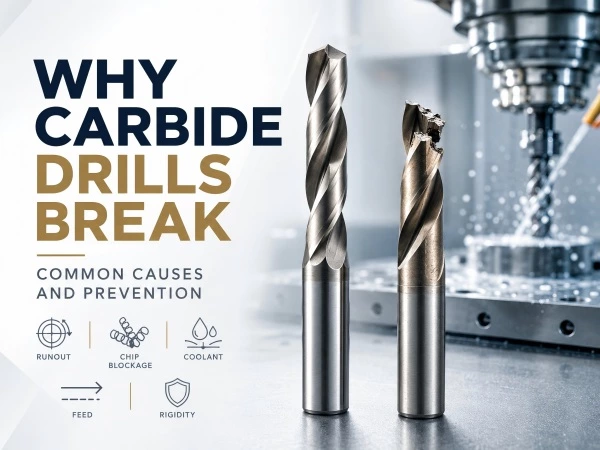
Excessive runout, unstable clamping, incorrect entry conditions or chip blockage can cause a carbide drill to chip or break. The machine, toolholder and drilling process must therefore be suitable for the tool.
Main Differences Between Solid Carbide and HSS Drills
| Comparison factor | Solid carbide drill | HSS drill |
|---|---|---|
| Initial purchase cost | Higher | Lower |
| Rigidity | High | Lower |
| Toughness | Lower | Higher |
| Cutting-speed capability | Generally higher | Generally lower |
| Wear resistance | Higher | Lower |
| Hole consistency | Better in stable CNC setups | Suitable for general drilling |
| Sensitivity to runout | Higher | More tolerant |
| Deep-hole capability | Strong with suitable design and coolant | More limited in high-productivity applications |
| Internal-coolant options | Widely available | Less common |
| Resharpening | Possible with professional equipment | Generally easier |
| Typical application | CNC batch production | Maintenance and low-volume work |
| Machine requirement | Stable spindle and rigid setup | More tolerant of unstable conditions |
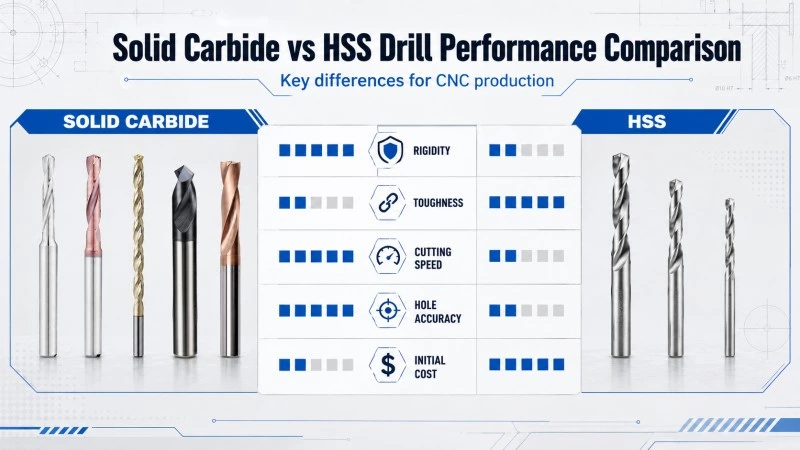
These are general differences rather than absolute rules.
Actual drill performance also depends on:
-
Tool geometry
-
Carbide or HSS grade
-
Surface treatment
-
Coating
-
Workpiece material
-
Hole depth
-
Coolant delivery
-
Cutting parameters
-
Machine condition
Why Manufacturers Are Moving Toward Solid Carbide Drills
The movement from HSS to carbide is not driven only by material hardness.
It is mainly driven by production economics.
Modern manufacturers are under pressure to:
-
Reduce cycle time
-
Increase machine utilization
-
Improve hole consistency
-
Reduce operator intervention
-
Lower tool-change frequency
-
Reduce rejected components
-
Support automated machining
-
Maintain predictable production output
A drill with a lower purchase price may become expensive if it requires slower cutting conditions, frequent replacement or repeated correction of hole-quality problems.
Solid carbide drills are often selected because they can support a faster, more controlled and repeatable drilling process.
Higher Productivity Potential
Carbide can generally operate at higher cutting speeds than HSS when the machine, coolant and setup are suitable.
This can reduce drilling time, especially when one component contains many holes or when the same operation is repeated across a large production batch.
Even a small reduction in machining time per hole can create a meaningful productivity improvement.
However, cutting speed should not be increased without considering:
-
Drill diameter
-
Workpiece material
-
Hole depth
-
Machine power
-
Toolholder condition
-
Coolant method
-
Required hole tolerance
The objective is stable productivity, not simply the highest possible spindle speed.
Greater Rigidity
Carbide is significantly more rigid than HSS.
Greater rigidity helps reduce tool deflection during drilling and may improve:
-
Hole position
-
Hole straightness
-
Diameter consistency
-
Roundness
-
Entry stability
-
Repeatability
This advantage becomes more important when producing precise components or drilling holes with a higher length-to-diameter ratio.
Improved Wear Resistance
Carbide generally provides stronger wear resistance than HSS under suitable machining conditions.
This helps the drill maintain its cutting geometry over a larger number of holes.
More stable geometry can reduce gradual changes in:
-
Hole diameter
-
Cutting force
-
Burr formation
-
Surface quality
-
Chip shape
For batch production, predictable wear is often more valuable than achieving the maximum possible tool life.
Predictable tool life allows the drill to be replaced before failure, reducing unplanned machine stoppages and workpiece damage.
Why Cutting Speed Is Not the Only Consideration
Carbide drills are often promoted for higher cutting speed, but speed is only one part of the economic comparison.
Manufacturers should also evaluate:
-
Tool-change time
-
Machine downtime
-
Scrap and rework
-
Hole-quality consistency
-
Operator intervention
-
Tool inventory
-
Unexpected drill breakage
-
Inspection requirements
-
Production repeatability
A drill may cut quickly but still be unsuitable if it produces unstable chip evacuation in a blind hole.
Similarly, a low-cost drill may appear economical until frequent replacement reduces machine availability.
The most useful comparison is therefore not the purchase price of one drill. It is the total cost required to produce an acceptable hole.
Understanding Cost per Hole
Cost per hole provides a more realistic comparison between carbide and HSS drills.
A simplified calculation can include:
Tool purchase cost
+ Machine operating time
+ Tool-change time
+ Machine downtime
+ Scrap and rework cost
+ Inspection cost
÷ Number of acceptable holes produced
Consider two drilling tools:
-
Drill A has a lower purchase price but requires slow cutting and frequent replacement.
-
Drill B costs more but produces more acceptable holes with less machine downtime.
Drill B may provide a lower cost per hole even though its initial price is higher.
This is particularly relevant in:
-
Automotive manufacturing
-
Aerospace machining
-
Precision engineering
-
Mold production
-
Medical-component manufacturing
-
Electronics production
-
Other high-volume CNC applications
In occasional maintenance work, the result may be different because cycle time and tool-change frequency have less influence on total production cost.
Why Machine Rigidity Matters
Solid carbide drills require a stable cutting system.
Because carbide is highly rigid, it does not tolerate bending and impact in the same way as HSS.
Important setup conditions include:
-
Spindle accuracy
-
Toolholder condition
-
Tool runout
-
Workpiece clamping
-
Machine rigidity
-
Drill overhang
-
Hole-entry condition
-
Coolant delivery
-
Feed stability
Excessive runout can cause one cutting edge to carry more load than the other.
This may lead to:
-
Uneven edge wear
-
Oversized holes
-
Poor hole position
-
Vibration
-
Chipping
-
Premature drill failure
The shortest suitable drill should normally be selected.
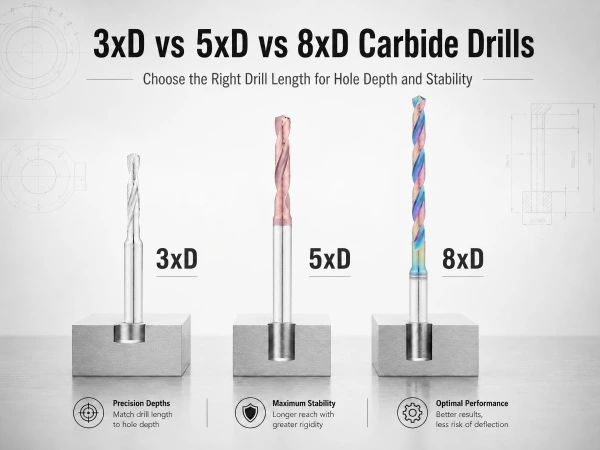
For example, a 3xD drill is generally more rigid than an 8xD drill of the same diameter. When the required hole is shallow, using an unnecessarily long drill may reduce process stability.
Performance in Different Workpiece Materials
The decision between carbide and HSS also depends on the material being drilled.
Steel
Solid carbide drills are widely used for carbon steel, alloy steel and general engineering steel in CNC production.
They can support higher productivity and more consistent hole dimensions under stable machining conditions.
Important factors include:
-
Steel grade
-
Material hardness
-
Hole depth
-
Chip shape
-
Coolant access
-
Drill coating
-
Cutting parameters
HSS remains suitable for occasional drilling, repair work and machines with limited rigidity.
Stainless Steel
Stainless steel can generate high cutting heat, long chips and work hardening.
A solid carbide drill with suitable geometry and coolant delivery can provide more stable performance in batch production.
The drill should support:
-
Controlled chip formation
-
Efficient chip evacuation
-
Stable cutting engagement
-
Resistance to edge wear
-
Reduced material adhesion
Incorrect cutting conditions can still cause carbide drills to fail.
Insufficient feed may create rubbing and work hardening, while poor coolant access can increase heat and chip accumulation.
Aluminum
Aluminum is relatively soft, but it can adhere to the cutting edges and flute surfaces.
A drill for aluminum should provide:
-
Sharp cutting edges
-
Smooth flute surfaces
-
Sufficient chip space
-
Low cutting friction
-
Reliable lubrication
-
Controlled burr formation
Both HSS and carbide can drill aluminum.
Carbide generally provides more value in high-speed CNC production, precision holes and large production quantities. HSS may remain sufficient for low-volume general drilling.
Cast Iron
Cast iron often produces short chips but can create abrasive wear.
Carbide drills may offer better wear resistance in continuous production.
The drill selection should consider:
-
Gray cast iron or ductile iron
-
Casting skin
-
Interrupted entry
-
Abrasive particles
-
Dry or coolant-assisted machining
HSS may still be suitable for low-volume or less-demanding cast-iron drilling.
Titanium Alloy
Titanium generates concentrated cutting heat and places high demands on the drill edges.
Carbide is commonly preferred for controlled CNC production because of its rigidity and wear resistance.
Performance depends heavily on:
-
Coolant delivery
-
Cutting speed
-
Feed rate
-
Tool runout
-
Hole depth
-
Chip evacuation
A carbide drill cannot compensate for an unstable process. Titanium drilling requires coordinated tool selection, cutting parameters and coolant control.
Selecting the Correct Carbide Drill Length
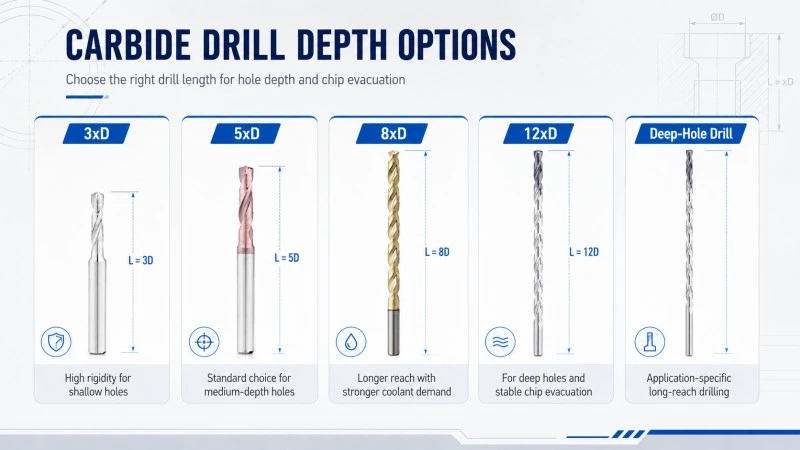
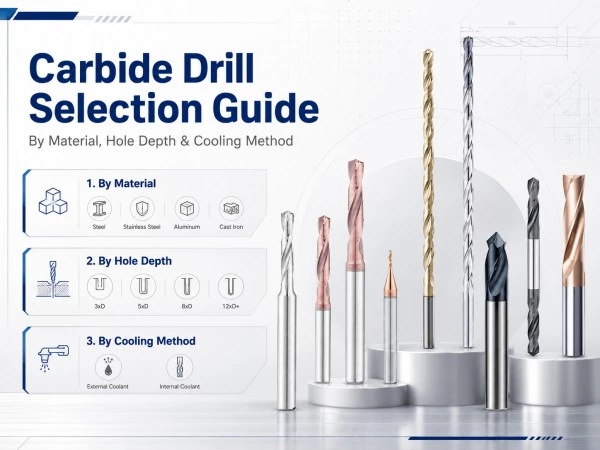
Once carbide has been selected, the drill length should match the required hole depth.
Common drilling-depth ratios include:
-
3xD
-
5xD
-
8xD
-
12xD
-
15xD
-
20xD
-
30xD and longer custom designs
3xD Carbide Drills
A 3xD drill is suitable for relatively shallow holes.
Its shorter structure provides high rigidity and makes it a common choice for general CNC drilling.
5xD Carbide Drills
A 5xD drill provides additional reach while maintaining a relatively stable structure.
It is commonly used for medium-depth holes in steel, stainless steel, aluminum and cast iron.
8xD Carbide Drills
At approximately 8xD, chip evacuation and coolant delivery become more important.
Internal coolant may be beneficial, particularly for stainless steel and other materials that generate difficult chips.
12xD and Longer Deep-Hole Drills
Deep-hole drilling requires more than simply selecting a longer tool.
The process may also require:
-
A pilot hole
-
Internal coolant
-
Suitable coolant pressure
-
Stable tool entry
-
Controlled spindle speed
-
Reduced runout
-
Correct retraction procedures
Long drills should be used according to the recommended entry and operating method.
Internal Coolant vs External Coolant
Coolant method can significantly affect drill performance.
External-Coolant Drills
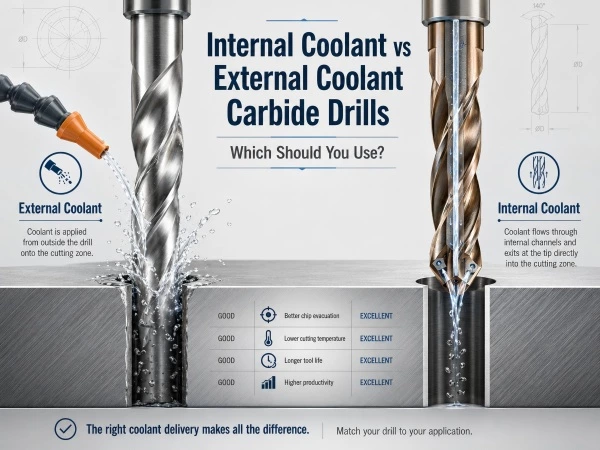
External coolant is directed toward the drilling area from outside the tool.
It can be effective for:
-
Shallow holes
-
Accessible cutting zones
-
General CNC drilling
-
Machines without through-spindle coolant
Its effectiveness normally decreases as the drill moves deeper into the workpiece.
Internal-Coolant Drills
Internal-coolant drills deliver coolant through channels inside the tool.
This can help:
-
Bring coolant closer to the cutting edges
-
Remove chips from deeper holes
-
Control cutting temperature
-
Support stable batch production
Internal coolant also requires suitable machine capability.
The system must provide sufficient:
-
Coolant pressure
-
Coolant flow
-
Filtration
-
Toolholder sealing
-
Channel cleanliness
Internal coolant is not automatically necessary for every operation, but it becomes more valuable as hole depth and chip-evacuation difficulty increase.
Coated vs Uncoated Carbide Drills
Many carbide drills use coatings to improve performance in specific materials.
A suitable coating may help:
-
Improve wear resistance
-
Reduce friction
-
Control heat
-
Reduce material adhesion
-
Maintain cutting-edge performance
However, coating is only one part of the drill design.
The carbide substrate, point geometry, flute shape, edge preparation and coating must work together.
For aluminum and other adhesive materials, an uncoated or specially treated drill may sometimes support better chip flow than a conventional coated drill.
For steel and stainless steel, suitable coatings are often used to improve wear resistance and thermal stability.
The coating should be selected according to the application, not simply according to appearance.
When HSS Drills Are Still the Better Choice
Solid carbide is not automatically the best option for every drilling operation.
HSS drills may remain more practical when:
-
The machine has limited rigidity
-
The spindle has noticeable runout
-
The workpiece is clamped manually
-
Drilling is performed with portable equipment
-
Production quantities are low
-
The drill is used only occasionally
-
The application involves maintenance or repair
-
Frequent onsite resharpening is required
-
Cutting conditions are unstable
-
Initial tool cost is the primary concern
HSS can tolerate more bending and impact than carbide.
For a workshop drilling only a few holes each week, the productivity advantage of carbide may not justify the higher tool and machine requirements.
When Solid Carbide Drills Provide the Greatest Value
Solid carbide drills normally provide the greatest value when the application involves:
-
Stable CNC machines
-
Medium- or high-volume production
-
Repeated drilling cycles
-
Tight hole tolerances
-
High-value components
-
Automated manufacturing
-
Deep holes
-
Internal coolant
-
Difficult-to-machine materials
-
Limited tolerance for tool changes
-
Documented process control
Carbide is particularly useful when consistent performance is required across hundreds or thousands of holes.
In these conditions, rigidity, wear resistance and application-specific geometry can create significant productivity advantages.
Can HSS Drills Be Replaced Directly with Carbide?
Replacing an HSS drill with a carbide drill of the same diameter does not always create an immediate improvement.
The drilling process should also review:
-
Machine rigidity
-
Toolholder accuracy
-
Tool runout
-
Cutting speed
-
Feed rate
-
Coolant delivery
-
Hole depth
-
Tool entry
-
Workpiece clamping
Carbide normally requires different cutting parameters from HSS.
Using the previous HSS parameters without adjustment may prevent the carbide drill from working efficiently.
In some cases, insufficient feed causes rubbing rather than cutting. In other cases, excessive speed or inadequate cooling causes rapid wear.
Replacing HSS with carbide should therefore be treated as a process upgrade rather than a simple tool-material substitution.
How to Decide Which Drill to Use
Choose an HSS drill when:
-
Production volume is low
-
The machine is not highly rigid
-
The setup has unavoidable vibration
-
Drilling is manual or portable
-
Tool purchase price is the main concern
-
Frequent onsite resharpening is required
Choose a solid carbide drill when:
-
Production is performed on a stable CNC machine
-
Hole consistency is important
-
Higher productivity is required
-
Production volume is medium or high
-
Deep holes or internal coolant are involved
-
Tool-change frequency must be reduced
-
Cost per acceptable hole matters more than initial tool price
When the application is uncertain, evaluate the complete drilling process rather than selecting a tool only by diameter and material name.
Frequently Asked Questions
Are carbide drills always better than HSS drills?
No. Carbide drills generally provide higher rigidity, wear resistance and productivity in stable CNC production. HSS drills may be more suitable for manual equipment, low-volume work and unstable setups.
Why are carbide drills more expensive?
Carbide material, precision grinding, edge preparation, coating and inspection contribute to a higher manufacturing cost. The initial price may be offset by increased productivity and a lower cost per hole.
Can carbide drills be resharpened?
Yes. Many solid carbide drills can be professionally resharpened and recoated. Feasibility depends on drill diameter, wear condition, geometry and tolerance requirements.
Do carbide drills require internal coolant?
Not all carbide drills require internal coolant. External coolant can be effective for shallow holes. Internal coolant becomes more valuable for deeper holes, difficult chips and continuous production.
Why do carbide drills break suddenly?
Common causes include excessive runout, unstable clamping, incorrect feed, chip blockage, insufficient coolant, excessive overhang and improper tool entry.
Can the same HSS cutting parameters be used for carbide drills?
Usually not. Carbide drills require parameters suited to their rigidity, geometry and coating. Workpiece material, machine condition and hole depth must also be considered.
Which is more important: tool life or cost per hole?
Cost per acceptable hole is normally the more useful production measure. A drill with longer life may still be uneconomical if it requires slow cutting or creates excessive downtime.
Conclusion
HSS drills remain useful for manual drilling, maintenance work, low production quantities and machines with limited rigidity.
Solid carbide drills are better suited to modern CNC production where higher productivity, hole consistency, wear resistance and process repeatability are required.
The correct choice depends on more than the purchase price.
Manufacturers should evaluate:
-
Machine condition
-
Workpiece material
-
Hole depth
-
Coolant method
-
Required tolerance
-
Production quantity
-
Tool-change frequency
-
Cost per acceptable hole
For stable CNC batch production, solid carbide drills often provide stronger long-term value. For low-volume or less-controlled drilling conditions, HSS may remain the more practical option.
Discuss Your Drilling Application
Landun CNC Tool supplies standard, micro, deep-hole, internal-coolant and custom solid carbide drills for different materials and drilling conditions.
Customers can provide the workpiece material, hole diameter, hole depth, machine type, coolant method and current drilling problem for technical evaluation.
 Need a Custom Tool solution?